In many schools of Okinawan karate, before the development of the formal
styles known today (e.g., shorin-ryu, goju-ryu, or uechi-ryu), naihanchi
shodan was often the first kata learned by a novice karateka. It introduces
the concepts of generating power in a small space with isolated movements as
well as the way to block an attack while delivering a counterattack
simultaneously.
Naihanchi was originally created as a single kata, practiced for between one
and three years under the tutelage of a teacher, until it was mastered. Today,
naihanchi is taught as three separate katas, usually in the intermediate
ranks, between kihon (basic) and fukyu (foundation) katas and the advanced
katas of passai or kusanku.
Four Star General Norman Schwarzkopf is one of America’s most vaunted military
leaders and a true hero. As commander of the United States Central Command, he
orchestrated and led the quick and decisive defeat of one of the world’s most
notorious villains, Saddam Hussein, during the Gulf War in 1990.
“Stormin’ Norman,” as he was known by his men, was a tough and valiant
warrior, having served in the Vietnam War as a battalion commander. His roots
were anchored in a military lifestyle, his father having also served in the
United States Army in World War II. Both father and son were graduates of the
United States Military Academy at West Point.
One of the greatest gifts of martial arts is that rising to any rank requires
struggle. It is struggle that makes us stronger, sharper, more skilled,
refined, tough and enduring. Rising to the level of Black Belt in the
Kiado-Ryu System of Martial Arts demands years of study and thousands of hours
of practice—always refining and developing our technique and character.
Martial Arts is Life and as martial arts is full of struggles and challenges,
so is life. As difficult as they seem, our struggles are designed to make us
better, not to destroy us; to give us a backbone, strength and courage to
stand tall and prevail against the forces assailing us.
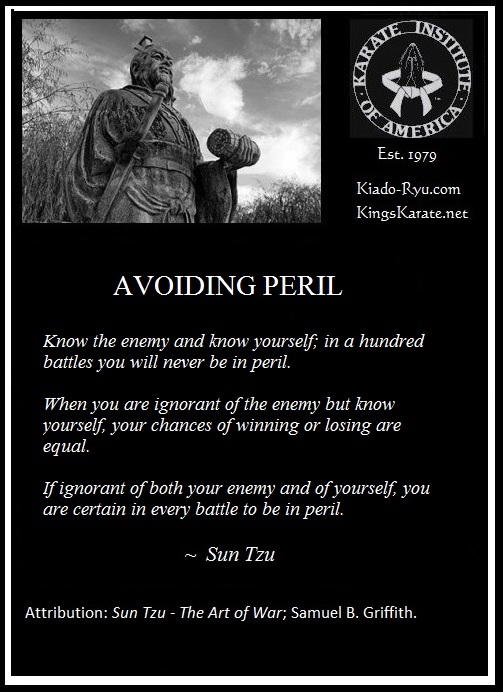
Great fighters are great thinkers. Battles are won with brain, not brawn. Sun
Tzu’s words of avoiding peril are as universally true today as they were in
his time.